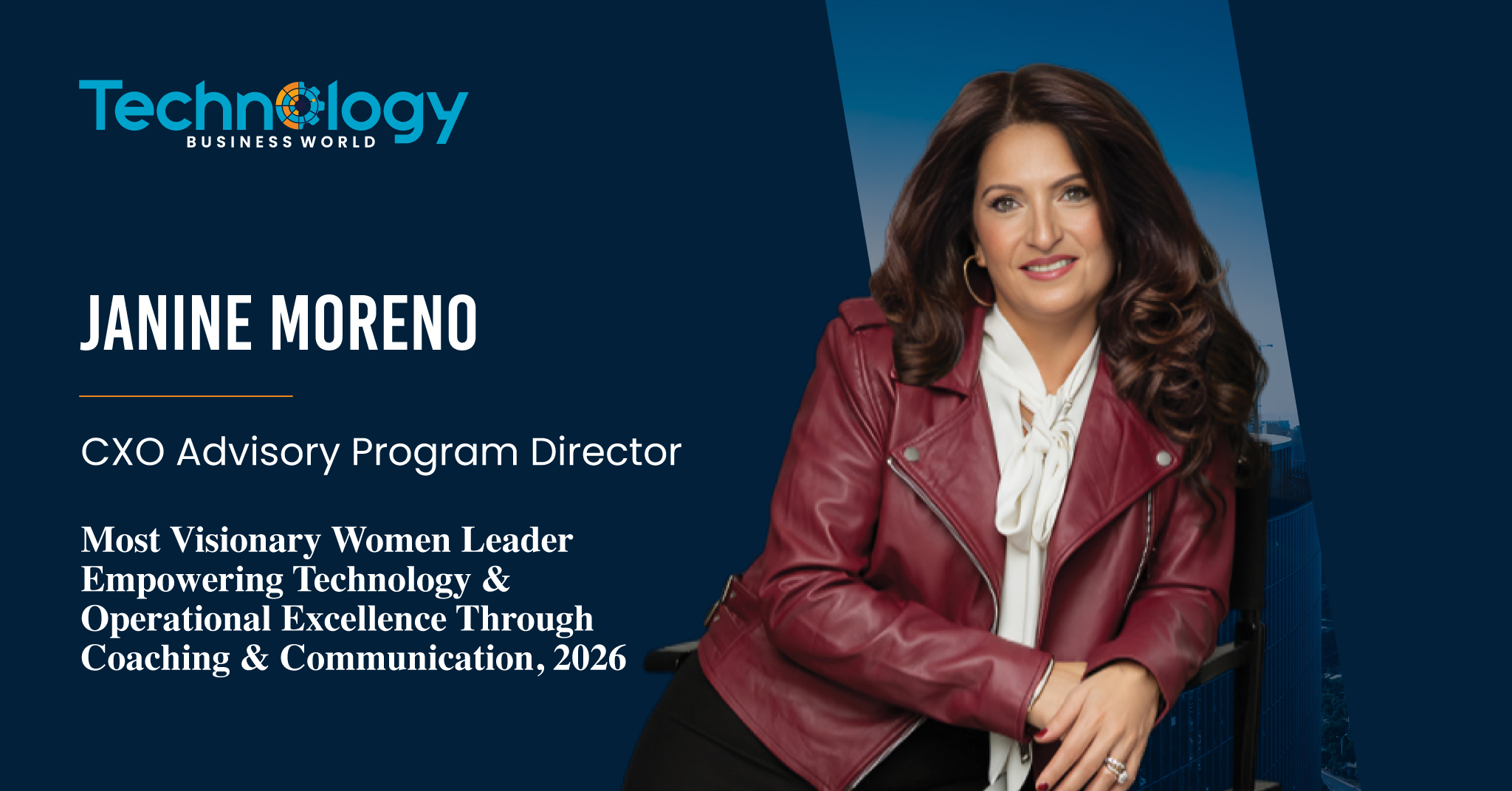
Leadership today is being tested in entirely new ways. The pressure is no longer limited to navigating organizational transformation, market uncertainty, or shifting customer expectations. Leaders are now being asked to make strategic decisions in an era where artificial intelligence is not simply assisting work but increasingly acting within it. As CXO Advisory Program Director at Dialpad, Janine Moreno operates at the center of these conversations, bringing senior executives together to navigate the intersection of leadership, technology, customer experience, and trust in a rapidly evolving business landscape.
With a career shaped by real operational leadership, difficult people decisions, and a deep understanding of what executive influence truly requires, Janine brings a perspective grounded equally in human judgment and strategic foresight. Her work today extends beyond advisory engagement. Through initiatives such as Dialpad’s Executive Exchange, Women in Leadership forums, Leadership Library conversations, and the emerging Passing the Torch mentorship platform, she is helping create meaningful spaces where senior leaders can move beyond surface-level discussions and engage honestly with the realities of transformation, AI adoption, and the future of enterprise leadership.
This cover story explores Janine Moreno’s leadership journey, her philosophy on mentorship, sponsorship, and authentic executive community-building, and her perspective on what human-centric AI leadership must look like in the era of Agentic AI. As organizations rethink how technology and people work together, her voice offers an important perspective on what thoughtful, modern leadership truly demands.
Let’s have detailed look into Janine’s insights;
In your journey, what has been the toughest leadership decision you’ve had to make that didn’t have a clear “right” answer?
Early in my career, I stepped into my first management role at a really challenging time. Our team was spread across five locations, and the company was going through a major transformation: downsizing and rethinking how we worked, which ultimately meant centralizing the team and reducing headcount.
What made it especially hard was that I wasn’t coming into a new team, I was now managing people I had been in the trenches with. These were colleagues I respected and had built real relationships with. Having to sit across from them and make decisions that would impact their jobs was something I wasn’t fully prepared for, and honestly, it stayed with me.
One situation in particular really tested me. One of our highest performers; someone in the top tier of the team, with deep experience and responsibility for a critical part of the business, became very negative about the changes. And to be fair, the uncertainty was real, and I understood where it was coming from.
But over time, that negativity started to spread. It was affecting the rest of the team at a moment when we needed to come together and move forward. I found myself facing a decision that didn’t have a clear “right” answer: do I hold onto a top performer who was essential in the short term, or do I prioritize the long-term health of the team?
I ultimately made the difficult decision to let that person go. It was tough. It created more work for everyone, and there were moments where I questioned whether I had made the right call. But I also knew I couldn’t ask the team to stay positive and committed if I wasn’t willing to protect that environment.
So I did what I could; I rolled up my sleeves and worked alongside them. I took on extra work, helped fill the gaps, and made sure they knew I wasn’t just making decisions from a distance.
Over time, something shifted. The team became more connected, more supportive of each other, and more focused. And I think, just as importantly, they saw that I was willing to stand with them, not just lead them.
That experience stuck with me. It taught me that some of the hardest leadership decisions aren’t about choosing between right and wrong, they’re about choosing what matters most, even when it comes at a cost.
How do you personally navigate the pressure of advising leaders who are themselves decision-makers at the highest level?
In my role as CXO Advisory Program Director at Dialpad, I stay grounded in the fact that senior leaders are not looking for more noise. They are looking for clarity, perspective, and a safe space for thoughtful leadership discussions where they can think out loud with peers.
That mindset is a big part of how I think about the work we are doing at Dialpad. Dialpad recognized that as businesses face the rapid changes and massive new opportunities brought on by AI, there’s a huge need for a forum where leaders can exchange ideas, share perspectives, and talk candidly about the challenges they are navigating.
Executive Exchange is the starting point for a broader thought leadership forum designed to bring senior leaders together for candid conversations about the technology trends, business challenges, and leadership issues shaping their organizations. From there, the dialogue can extend into Leadership Library sessions featuring authors and new ideas shaping leadership today, Women in Leadership forums that create space for connection and shared perspective, and more targeted industry and partner dialogues. Over time, it creates a stronger path to deeper, ongoing executive engagement.
We are also expanding that work through a new extension of Women in Leadership called Passing the Torch, a forum designed for senior leaders to bring their mentees into the room and learn from the collective wisdom, experience, and perspective of established leaders. I am excited about that because leadership development should not happen in isolation. The strongest communities create space not only for peer dialogue at the top, but also for the next generation to listen, learn, and build confidence in the room.
What makes those conversations valuable is that they are rooted in what is happening right now inside the enterprise. At Dialpad, I work closely with executives who are navigating major shifts in how work gets done and how they connect with their customers. AI is transitioning from providing insights and assistance to giving teams the ability to deliver better, more personalized customer experiences at scale. The nature of leadership conversations is changing. The pressure is not just about making the “right” technology call.
It is about making thoughtful decisions around trust, accountability, and where human judgment still has to lead.
What helps me most is staying curious, staying practical, and resisting the urge to oversimplify. The best executive conversations are rarely about surface-level trends. They are about where friction exists, where decisions break down, and what kind of leadership is required when systems can do more on their own.
How do you ensure that AI adoption remains human-centric rather than purely efficiency-driven?
For me, human-centric AI starts with a simple question: what should technology handle, and what should still belong to people?
I do not believe the goal is to remove humans from important decisions.
The goal is to remove unnecessary friction so people can spend more time on judgment, empathy, relationships, and the moments where a personal touch really matters.
At Dialpad, being at the forefront of agentic AI has only reinforced my perspective. We’re an AI platform for customer experience, bringing voice, video, messaging, and contact center capabilities into a single, unified solution with real-time intelligence at its core—helping organizations improve conversations, empower teams, and deliver better outcomes.
Because we approach AI through the lens of customer experience, we start from a simple premise: humans are at the center of every interaction, and AI should be designed to support them.
Too often, AI adoption is framed around efficiency—how much faster or cheaper work can be done. We see the question differently: not “What can AI do?” but “What should it do for our people and our customers?”
A human-centric approach starts with intent. AI should elevate judgment, creativity, and connection—not just output. That requires redefining success beyond efficiency to include trust, quality, and long-term relationships. If AI speeds things up but erodes experience or engagement, it’s not real progress.
Transparency is equally critical. People need to understand how AI fits into their work and where accountability lies. Without that clarity, adoption creates friction instead of value.
Finally, leaders must invest in their teams. AI adoption is as much a people challenge as a technology one. Organizations that succeed create space for learning, invite participation, and position AI as a tool employees shape—not just absorb.
Ultimately, human-centric AI reflects leadership discipline. It shows up in the questions leaders ask, the metrics they prioritize, and the culture they build.
What is the difference between mentorship and sponsorship—and why do many organizations fail to implement the latter effectively?
Mentorship and sponsorship get lumped together a lot, but they really are two different things.
Mentorship is someone taking the time to guide you; helping you think through challenges, giving advice, sharing their experience. It’s incredibly valuable, and I think most of us can point to mentors who helped shape how we think and grow.
Sponsorship is different. It’s when someone actually steps up and advocates for you; when they put your name forward for an opportunity, speak up for you in a room you’re not in, or take a chance on you. It’s a bit more personal, and honestly, it carries more weight because there’s some risk involved for the person doing it.
I think a lot of organizations struggle with sponsorship because it doesn’t happen as naturally as people think. It requires intention. It requires leaders to really know their people, see their potential, and be willing to back them. And the reality is, people tend to sponsor those they’re most comfortable with, often people who remind them of themselves; which can leave others out without anyone realizing it.
There’s also a tendency to assume, “If someone’s doing great work, they’ll get noticed.” But that’s not always how it works. Sometimes people need someone in their corner, helping create that visibility.
The companies that do this well are the ones where leaders see it as part of their role; not just to develop people, but to help create opportunities for them.
To me, mentorship helps you grow, but sponsorship is what really changes the trajectory of your career; and everyone deserves both.
You work closely with C-suite leaders—what does authentic community-building look like at that level?
To me, authentic community-building starts with intention.It is not about putting impressive titles in a room. It is about creating a trusted environment where senior leaders are willing to exchange ideas honestly, challenge each other thoughtfully, and talk candidly about what they are navigating.
That is exactly why we built the Executive Exchange at Dialpad. It is the starting point for a broader thought leadership forum, one designed to create a safe space for executives to share
perspective on leadership, transformation, and now Agentic AI. It’s not a presentation. It is a peer-level exchange where leaders can compare notes on what they are seeing, what is working, what concerns them, and where they are still uncertain.
From there, that dialogue can deepen in ways that extend the sense of community beyond a single conversation. That matters because strong executive communities should not only create trust among peers; they should also help develop the next generation of leaders.
For me, authentic community-building looks like openness. Less formality. More shared perspective. That is where the most meaningful conversations happen.
What is the biggest myth about leadership that you would like to break?
One of the biggest myths about leadership is that you’re supposed to have all the answers.
Early in my career, especially in my first management role, I felt that pressure a lot. I thought being a good leader meant being the one who knew exactly what to do in every situation. But the reality was, I was stepping into complex situations, organizational change, difficult people decisions; where there wasn’t a clear “right” answer.
What I learned over time is that leadership is much less about having all the answers, and much more about how you navigate the unknown. It’s about asking the right questions, listening to your team, and being willing to make a decision even when things aren’t perfectly clear.
I’ve also learned that a confident leader doesn’t need to be the smartest person in the room. When someone on the team has a better idea or a better solution, the best thing you can do is acknowledge it and celebrate it. That’s how you build trust, and it’s how you get to better outcomes as a team.
There were moments where I had to be honest and say, “I don’t have this fully figured out yet,” and I was surprised to find that it didn’t weaken trust; it actually strengthened it. It opened the door for more honest conversations and better ideas.
To me, leadership is really about judgment, transparency, and accountability. You won’t always get it right, but your team is looking at how you handle those moments: how you communicate, how you make decisions, and how you take responsibility for the outcome.
Letting go of the idea that I had to have all the answers made me a better leader, and, honestly, a more human one.
What has been a defining moment that shaped your leadership philosophy?
One of the defining moments that really shaped my leadership philosophy came early in my career, when I was still figuring out what kind of leader I wanted to be.
Like most new leaders, I was very focused on performance: delivering results, hitting deadlines, and building a strong, high-functioning team. I cared deeply about the work, and I expected a lot from my team. At the same time, I’ve always been a naturally empathetic person, and I remember feeling a bit of tension between those two things; driving results while also wanting to make sure people felt supported and respected.
That tension really became clear when I was given a project with what I would call a completely unrealistic deadline. Meeting it would have required the team to work 60-hour weeks for months. And I remember thinking, yes, we could probably get it done; but at what cost?
Up until that point, I hadn’t really pushed back on something like that. But this was the first time I paused and approached it differently. Instead of just accepting the pressure and passing it on to my team, I stepped back, looked at the work, and came up with an alternative plan; one that still met the business need, but proposed bringing in additional resources temporarily so we could get there without burning people out.
It was the first time in my career that I said “no; or at least, “not this way”and it was a turning point for me.
What stayed with me from that experience is that you can push a team, but only so far. And how you get results matters just as much as the results themselves. Celebrating wins, recognizing effort, respecting boundaries, and being mindful of the impact on your team isn’t a “nice to have”, it’s what people remember long after the work is done.
Over time, my leadership style has been shaped by both the best leaders I’ve worked for and the worse – ones I knew I didn’t want to emulate. And when I look back, the thing I’m most proud of isn’t just what we delivered; it’s the people. Seeing individuals I’ve worked with go on to have successful, fulfilling careers is what really stays with me.
That’s what ultimately shaped my philosophy: getting the job done is important, but how you lead people through it, and how they remember that experience, is what defines you as a leader.
How do you continue to evolve while operating at such a high strategic level?
I stay close to how leadership challenges are changing in real time.
One of the biggest shifts I am paying attention to right now is the evolution of AI itself; from traditional rules-based systems, to predictive models, to generative AI, and now to Agentic AI. At Dialpad, we define Agentic AI as AI that can autonomously pursue goals by reasoning, planning, taking actions, using tools, and adapting based on feedback over multiple steps. That progression is not just technical. It changes the strategic questions leaders need to ask.
Part of how I continue to evolve is by staying in active dialogue with executives who are working through those questions in real time. That is one of the reasons Dialpad has been intentional about establishing forums like the Executive Exchange. We recognize that leaders need space to exchange ideas, challenge assumptions, and learn from each other as technology, leadership, and the nature of work continue to evolve.
That keeps me learning. It forces me to keep refining my own thinking, not just about what technology can do, but about what leadership must look like when technology can do more.
I also believe evolution at a high level requires humility. You cannot advise leaders well if you stop listening. The best insight still comes from staying in conversation with people who are dealing with real pressure, real tradeoffs, and real change.
What keeps you grounded amidst constant engagement with high-performing leaders?
What keeps me grounded is focusing on the people behind the work and remembering where I came from. Early in my career, I was just trying to figure things out, learning, making mistakes, and growing along the way. That perspective has stayed with me.
Being around high-performing leaders is inspiring, but it’s also a reminder that no one has it all figured out. The best leaders I’ve worked with aren’t focused on themselves; they’re focused on their teams, on developing others, and on doing the right thing, even when it’s not the easiest path.
I try to carry that with me. Titles and roles come and go, but how you treat people and the impact you have on them is what really lasts.
Early on, I also built a habit that’s stayed with me. At the end of each day, I would take a few minutes to reflect on my interactions, how I showed up, how I made people feel. If something didn’t sit right with me, I made it a priority to address it the next day. That meant checking in with that person, making sure they were okay, and if I didn’t handle something the right way, owning it and making it right.
At the end of the day, that kind of reflection keeps you grounded. It reminds you that leadership isn’t just about outcomes, it’s about people.
What will define the next generation of CXO leadership?
The next generation of CXO leadership will be defined by how well leaders leverage increasingly autonomous systems alongside their human teams to deliver the best results for their organizations.
For a long time, leadership was measured by how well you could drive decisions, lead teams, and scale through people and process. That still matters. But leaders now also have to decide where AI should act, where oversight is required, and where accountability must stay clearly human.
What stands out to me in Dialpad’s Agentic AI work is that this is not just AI responding to prompts.It is AI that can autonomously pursue goals by reasoning, planning, taking actions, using tools, and adapting based on feedback over multiple steps. That is a meaningful shift. It changes not only how work gets done, but how leaders think about trust, governance, and decision-making.
The differentiator will not be speed alone.It will be whether leaders can put the right guardrails in place, know where autonomy creates real value, and make sure human judgment stays where it matters most.
The strongest CXO leaders will be the ones who can hold both sides of that equation. Ambition and restraint.
Innovation and accountability.
Efficiency and judgment.
What advice would you give to emerging leaders who aspire to influence at the executive level?
Learn how to translate complexity into clarity.
Emerging leaders sometimes assume executive influence comes from having the loudest voice in the room or the most polished point of view. In my experience, it comes more from asking the right questions, seeing around corners, and helping leaders make sense of what matters most.
That is especially true right now as AI becomes part of more strategic conversations. Do not just learn the technology.Learn the implications. Ask where it creates value, where it introduces risk, what needs guardrails, and what should remain deeply human.
At Dialpad, one of the most useful lessons from the Agentic AI conversation is that the future will not belong only to technical experts. It will belong to leaders who can connect technology to trust, operations, customer experience, and sound judgment without losing the human center.
That is the muscle I would encourage emerging leaders to build.
The leaders who will stand out in this next chapter will be the ones who can create the conditions for technology, judgment, and people to work well together. For those who want to continue the conversation, Dialpad’s Executive Exchange offers a trusted, peer-level forum for executives to exchange ideas, share perspectives, and learn from one another. And for those who want to see Agentic AI in action, Dialpad’s Agentic Labs provides real workflows, real autonomy, and real proof of Agentic AI.